Are there other techniques for that purpose. Describe the technique you would use to separate these proteins.

Bio Biochem 1a Amino Acids Peptides Proteins Part 2 Flashcards Quizlet
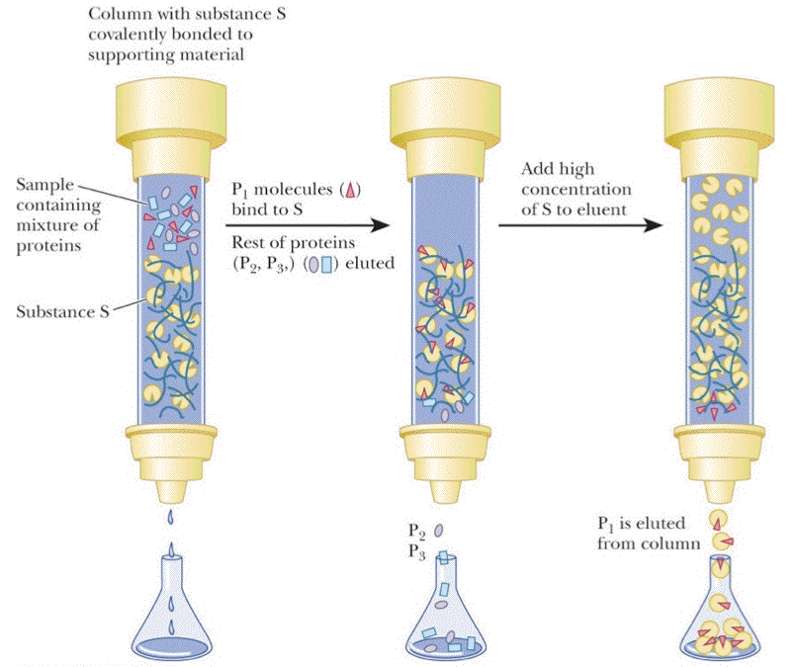
Items 4 items Drag and drop into the appropriate area below Adding a strong salt and making the protein precipitate Immobilizing a proteins ligand to capture the protein of Eluting of proteins by.
. Consequently it is often of great interest to ascertain whether two purified proteins interact and how this interac- tion affects their properties. The major proteins in soluble cell extracts can be purified by column chromatography. Because nucleic acids negatively charged ions at neutral or basic pH in aqueous environment this technique is often used to separate DNA or RNA molecules.
Ion-exchange chromatography separates molecules based on their ionic interactions. Gel electrophoresis is used to separate macromolecules like DNA RNA and proteins. The most commonly used technique for protein separation is sodium dodecyl sulfate polyacrylamide gel electrophoresis SDS-PAGE.
Proteins of the same length usually cann ot be separated by gel electrophoresis SDS. Polyacrylamide SDS Gel Electrophoresis Mechanism 1. Proteins are made up of amino acid letters some of which are sometimes charged depending on pH.
The stationary phase is a resin that supports ionic functional groups and retains molecules of the opposite charge. This part is performed by IEF. Protein Purification Techniques A.
The principle is that smaller molecules have to traverse a larger volume in a porous matrix. Affinity chromatography is a very useful technique for polishing or completing the protein purification process. Depending on the amino acid composition the net charge will most likely be different at a given pH obviously dont use a pH near the isoelectric point as the protein will have low mobility -.
Use the isoelectric point pI to guide you and your protein of interest on your Ion EXchange chromatography IEX journey. Beads in the chromatography column are cross-linked to ligands that bind specifically to the target protein. Matrix has an ion load opposite to that of the protein to be separated and the affinity of the protein to the column is achieved with ionic ties.
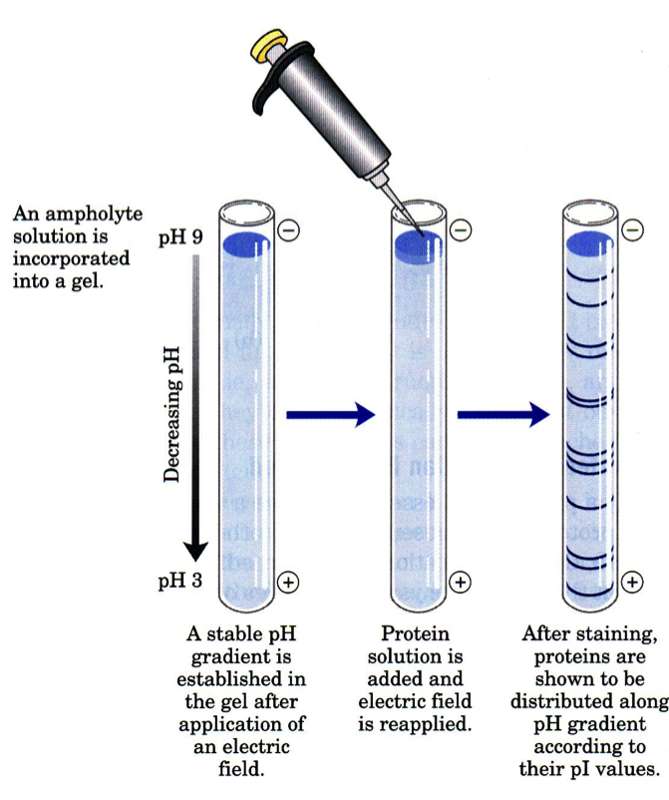
Using this technique proteins are separated on the basis of their pI the pH at which a protein carries no net charge and will not migrate in an electrical field. 2D Gel Electrophoresis Two-dimensional gel electrophoresis 2D electrophoresis is a form of gel electrophoresis commonly used to analyze proteins in which mixtures of proteins are separated by two properties in two dimensions on. Electrophoresis is used to separate complex mixtures of proteins eg from cells subcellular fractions column fractions or immunoprecipitates to investigate subunit compositions and to verify homogeneity of protein samples.
A conditioning step is applied to proteins separated by. This method is based on the attraction between oppositely charged ions so a cationic stationary phase is used to separate anions in cation-exchange chromatography and an anionic stationary phase is used to separate cations in anion. In polyacrylamide gel electrophoresis proteins migrate in response to an.
Proteins can be separated from each other based on a number of different characteristics. The differences in molecular weight caused by differences in the R groups are not enough to allow a separation. Proteins can be separated according to solubility size charge and binding affinity.
In a typical purification the sample is passed through several different columns in turnthe. By making use of a pH-gradient that can for example be induced by ampholytes this technique allows to separate protein isoforms up to a resolution of 002 delta-pI. The protein is then removed from the column by rinsing with a solution containing free ligands.
Proteins can be separated according to their size and their charge different proteins have different charges. So electrophoresis SDS separates on the basis of molecular weight not on the basis of native charge. This is the technology behind capillary isoelectric focusing cIEF instrumentation.
Gel Permeation Chromatography 1-4 Gel permeation chromatography separates protein mole-. Also useful to isolate and extract DNA fragments of a specific size. Between specific proteins can affect their functionality in the system.
Match each separating characteristic with the appropriate technique. So if you want to purify your negatively charged protein youll pass it through a positively charged resin. I know ion exchange chromatography and Isolectric focusing separate proteins based on their charge.
Ion exchange chromatography is a technique used to separate molecules or proteins according to their charge. Method used to separate charged macromolecules of different sizes and to estimate their length. It can also serve to purify proteins for use in further applications.
Be specific and note what should be on the solid matrix of the column or - charge hydrophobic bit ATP whatever and what solution you would use to. IEX is a common protein purification technique in which we separate proteins based on charge. The other principal method of separating proteins by charge is to allow them to migrate along a pH gradient in an electric field coming to rest at the pH at which their net charge is zerothe proteins isoelectric point Pi.
Chromatography can be used to separate protein in solution or denaturing conditions by using porous gels. Free-flow electrophoresis FFE is a carrier-free electrophoresis technique that allows preparative protein separation in a laminar buffer stream by using an orthogonal electric field. Consequentially proteins of a certain range in size will require a variable volume of eluant solvent before being.
Proteins are separated from the column either by changing pH concentration of ion salts or ionic strength of the buffer solution. What techniques are used to separate proteins based on their charge. This technique is known as size exclusion chromatography.
Use gel electrophoresis to separate PCR amplified DNA fragments. Positively charged ion- exchange matrices are called anion-exchange matrices and adsorb. Depending on the type of column matrix biologically active proteins can be separated on the basis of their molecular weight hydrophobicity charge characteristics or affinity for other molecules.
SDS-PAGE separates proteins mainly on the basis of molecular weight as opposed to charge or folding. The technique is capable of extremely high resolution with proteins differing by a single charge being fractionated into separate bands. SDS allows the proteins to migrate based on their size.
It is a negatively charged ionic detergent that is used in polyacrylamide SDS gel electrophoresis. Allows the protein to migrate at different rate in the gel based on their SIZE. The molecules that dont bind or.
DNA fragments are separated according to their size.
Protein Purification Methods

The Principle And Method Of Polyacrylamide Gel Electrophoresis Sds Page Mbl Life Science Japan Life Science Science Principles
Protein Purification Methods
Protein Purification Methods




0 Comments